The Shell Companies and Broken Promises of the Robynne Alexander Case
The Non-Financial Ledger: What Money Cannot Repay
The SEC complaint filed against Robynne Alexander catalogs dollar amounts with clinical precision. It accounts for $820,000 misused from one project, $327,000 redirected from another, $50,000 taken here, $75,000 taken there. The numbers are documented, cited, and damning. But numbers on a federal complaint page cannot capture what it actually feels like to hand your savings to someone you trusted, then spend the next three, four, or five years sending emails into a void, receiving no answers, and slowly realizing the investment you were building your future on was already gone.
Many of Alexander’s investors were people she had personally coached. She was paid by a company to provide, in the complaint’s own words, “education on foundational real estate investing principles, personalized mentorship and advice, and connections in the real estate investing industry.” These were students. People who came to her wanting to learn how to build wealth. People who trusted her not because of a cold pitch, but because of a relationship she had cultivated in a professional setting over time. That relationship was the product she sold them, and then she sold it again when she took their investment money. The betrayal at the center of this case is not purely financial. It is personal. It is the weaponization of mentorship.
Consider what it means to invest $750,000 in a project, as Investor G did in May 2021. That is a life-altering sum of money for most people. The Investor G Operating Agreement promised that Elm and Baker, LLC would own the property outright by June 30, 2021, and if it did not, the money would be returned with 8% interest. The property was not transferred until January 27, 2022. The money was not returned. The interest was not paid. And by the time the property went into foreclosure in May 2023, approximately $327,000 of that $750,000 had already been used to pay off two earlier investors who had nothing to do with this project. Investor G was not told this. Investor G received no meaningful update. The complaint does not say Investor G has been made whole, because Investor G has not been made whole.
Investor H’s story adds a different dimension to the betrayal. Beginning in March 2021, Investor H wired money to Alexander in four installments over seven months, totaling $150,000. The operating agreement Investor H signed contained different terms than the one Investor G signed for the exact same LLC at the exact same time. Two investors, one entity, two contradictory governing documents. At least $50,000 of Investor H’s money was used for “project expenses unrelated to Elm and Baker, numerous loans to herself or other business entities, and personal expenses such as grocery bills.” Grocery bills. Someone’s $150,000 investment in their financial future was used, in part, to buy food for Robynne Alexander.
The HB9G investors faced a particular kind of psychological torment. Between 2020 and 2023, they sent repeated requests for updates on their investment in a Hampton, New Hampshire property. Three years passed. When Alexander finally responded in April 2023, she told them the property was in a “deteriorated state” and needed $100,000 in renovations. She did not tell them the property would go into foreclosure seven months later. When it did foreclose in November 2023, she did not tell them that either. Instead, 13 days after foreclosure, she emailed them about a $40 million loan she was supposedly securing for an unrelated project. That $40 million loan did not exist. The HB9G investors still have not been repaid. They were not investing in a property. They were investing in a lie that was updated with new lies as the original ones expired.
Investor B’s story is perhaps the starkest accounting of what this scheme cost in raw human terms. Investor B invested $250,000 in Legacy at Laconia in October 2023, with a promissory note promising repayment plus 15% interest by February 2024. Before that, the same Investor B had already put $100,000 into a property at 9 Cross Street in Somerville, Massachusetts. Both investments are gone. The 9 Cross Street property is in foreclosure. The Laconia purchase agreement was terminated by the State of New Hampshire. At least $75,000 of the $250,000 investment was spent by Alexander on other projects, personal living expenses, and personal travel to Paris, Barcelona, Valencia, Nassau, Florida, and New Orleans in October and November 2023. That is to say: Investor B’s money was in Alexander’s account when she bought plane tickets to Europe and the Caribbean. That is the ledger item no spreadsheet captures.
Legal Receipts: The Exact Words That Seal the Case
These are not paraphrases. These are the direct allegations, factual statements, and verbatim passages from the SEC’s complaint filed June 26, 2025 in the United States District Court, District of New Hampshire. Case No. 1:25-cv-00242. Every word below comes directly from the source document.
“Between at least 2018 and 2024, Robynne Alexander (‘Alexander’) defrauded investors who purchased securities in various real estate investment projects. Alexander raised a total of more than $4 million from at least 28 investors in connection with eight real estate investment projects. Alexander represented to her investors that she would purchase, renovate, and sell properties for profit. However, she defrauded investors and misappropriated investor funds by using a substantial amount of investor money to pay fake investment returns to certain favored investors, to repay some investors and lenders in unrelated projects, and as her primary means of paying her personal expenses.” SEC Complaint, Paragraph 1 — Preliminary Statement
“She never notified investors when she disposed of a property or when it was foreclosed upon; she rarely provided updates to investors and when she did, it was only after repeated requests; she never kept accurate books and records; and some purported investment returns paid to investors were not derived from profits on the projects but were made by taking money from some investors to pay off others.” SEC Complaint, Paragraph 1 — Preliminary Statement
“As a result of Alexander’s misrepresentations and deceptive conduct in connection with the offer and sale of the securities related to these real estate investment projects, investors have lost at least $3 million.” SEC Complaint, Paragraph 2
“Alexander did not raise the Minimum Dollar Amount by July 27, 2018, the date the property was ‘no longer under contract,’ she was not entitled to use investor funds for any purpose, including collecting any management fees. Despite having been obligated to return the Raxx-LeMay investors’ funds as of July 27, 2018, Alexander went on to use investor money for other purposes that were not permissible under the Raxx-LeMay PPM.” SEC Complaint, Paragraphs 20–21
“Between July 2018 and November 2018, Alexander used Raxx-LeMay investor funds as collateral to draw $1.3 million from a line of credit held in the name of another entity she owned and controlled. In September and October 2018, Alexander then used a portion of the $1.3 million to pay back at least four investors in projects other than Raxx-LeMay, in an amount totaling approximately $282,000.” SEC Complaint, Paragraph 24
“All told, Alexander misused at least $820,000 of Raxx-LeMay investor money for purposes that had nothing to do with acquiring and renovating the two properties.” SEC Complaint, Paragraph 26
“Investors C and D learned that Alexander had not filed Raxx-LeMay’s tax returns, that Alexander failed to keep ordinary business records, that Alexander was struggling to keep up with payments to Raxx-LeMay’s hard money lender, and that Alexander would not be able to finance the renovation of the Raxx-LeMay buildings.” SEC Complaint, Paragraph 27
“Alexander did not have the authority to transfer the property from Raxx-LeMay to Signature on Elm without the knowledge and consent of Raxx-LeMay investors… Not only did Alexander violate this provision in the Raxx-LeMay Operating Agreement, she kept the other Raxx-LeMay investors in the dark despite the fact that Section 10.8 of the Raxx-LeMay PPM provides that Alexander ‘intends to conduct periodic teleconferences and/or email updates with the Members, as the Manager deems necessary to keep them apprised about affairs involving the Company.'” SEC Complaint, Paragraph 29
“As a result of the transfer, Raxx-LeMay, which did not have any interest in Signature on Elm, had no real estate holdings, a fact that was concealed from the other Raxx-LeMay investors whose investments then became worthless.” SEC Complaint, Paragraph 30
“At least five Raxx-LeMay investors did not receive financial statements, K-1s, or regular updates, including after repeated written and oral requests to Alexander regarding Raxx-LeMay.” SEC Complaint, Paragraph 31
“Alexander instead used approximately $327,000 of Investor G’s investment to repay Investors E and F $260,000, plus $67,000 in purported return on investment in June 2021. Alexander also used approximately $210,000 of Investor G’s investment to pay investors unrelated to the 4 Elm St. property in May and June of 2021.” SEC Complaint, Paragraph 40
“Alexander used at least $50,000 of Investor H’s investment for project expenses unrelated to Elm and Baker, numerous ‘loans’ to herself or other business entities, and personal expenses such as grocery bills. Each of these uses was an improper use of Investor H’s money.” SEC Complaint, Paragraph 43
“Despite her statements to investors, the property was never developed, the project failed, and the property went into foreclosure in May 2023.” SEC Complaint, Paragraph 44
“In an email to the HB9G investors on November 24, 2023, just 13 days after the property was foreclosed upon, Alexander said she was ‘working with several lenders that are helping us with working capital to exit you as an investor. [Lender A] is providing us a $40M loan which will be used for the purchase of a large property (21.5M) up in the lakes area and the remaining funding is to be used for operating capital.’ That representation was false. Alexander was not working with lenders relating to investors in HB9G.” SEC Complaint, Paragraph 49
“In another email on March 2, 2024, Alexander told investors that she was ‘fully approved for a large institutional line of credit which was originally only for the purchase of the State Property (Laconia). It has since been expanded to include any real estate transaction meaning we can use the funds for any of my real estate projects – past or present.’ That representation was false. Alexander had not been fully approved for a large institutional line of credit, nor was she ever approved for such.” SEC Complaint, Paragraph 50
“Despite Investor B’s funds being given to Legacy at Laconia, Alexander misappropriated at least $75,000 for payments related to other real estate investment projects, personal living expenses, and nearly $5,000 of personal travel expenses in Paris, Barcelona, Valencia, Nassau, Florida, and New Orleans in October and November 2023.” SEC Complaint, Paragraph 55
“On February 5, 2024, Alexander wired $81,579.00 to Investor A, a Raxx-LeMay investor, from the same Any Property Rehab bank account that held Investor B’s investment funds. Alexander thus improperly used Investor B’s investment funds to repay Investor A the principal investment amount and purported return-on-investment for the Raxx-LeMay project.” SEC Complaint, Paragraph 59
“At the time Investor B’s funds were deposited into Any Property Rehab’s account, the account balance was $204.45.” SEC Complaint, Paragraph 58
“Alexander sold the 23 Country Club Rd. property in May 2020 for $120,000. Despite having sold the property and telling the investor that repayment would come from the proceeds of the sale, Alexander used $77,000 of the money from the title company for the sale of the 23 Country Club Rd. property to repay an investor in a different property — 37 C St. Manchester, NH — on June 3, 2020. To date, Alexander has only paid $4,500 of the total amount due under the investment to the investor in the 23 Country Club Rd. property.” SEC Complaint, Paragraphs 62–63
The Money Map: Where $4 Million Actually Went
Per-project breakdown: funds raised (gold) vs. confirmed misappropriated (amber). Other projects totaled an additional $360,000 raised.
Societal Impact Mapping: The Damage Beyond the Balance Sheet
Environmental Degradation: Properties Left to Rot, Communities Left Behind
When investors hand money to a developer, part of what they are funding is the transformation of a building. Properties like the ones at the center of this case, commercial buildings on Elm Street in Manchester, a multifamily property in Hampton, a potential resort development on 217 acres in Laconia, represent physical space in communities. When development is promised and does not happen, those buildings do not stay frozen in time. They decay. They attract blight. They become liabilities for the neighborhoods that surround them.
The HB9G complaint details this trajectory in stark terms. By April 2023, more than three years after investors handed over $273,000 to acquire and renovate a multifamily property at 9 G Street in Hampton, New Hampshire, Alexander was telling them via email that the property was in a “deteriorated state” and needed “approximately $100,000 in renovations to bring it where it needs to be for high-season rentals.” The money for those renovations had already been spent, including $50,000 redirected to unrelated expenses in February 2020. The property went into foreclosure in November 2023. The community surrounding that address now has a foreclosed, deteriorated building sitting in it because investor funds intended to rehabilitate it were used to pay personal expenses instead.
The 4 Elm Street property in Manchester, New Hampshire followed the same arc. The Investor G Operating Agreement specifically described the purpose of the investment as developing the property “into an adaptive reuse conversion to apartments to be sold on the market.” Adaptive reuse, converting underutilized commercial buildings into housing, is precisely the kind of development that urban planners and housing advocates push for to address housing shortages in mid-sized cities like Manchester. That development never happened. The property went into foreclosure in May 2023. The building sits. The housing units do not exist. The community gets the downside of a stalled project and none of the promised upside.
The most environmentally significant unkept promise in this complaint involves the Legacy at Laconia project. Alexander signed a purchase agreement in November 2022 to buy a 217-acre property in Laconia, New Hampshire, formerly known as the “State of New Hampshire Lakes Region Facility.” The project’s website described it as a plan to “create a first in the world, innovative, world class resort implementing universal design with barrier free accessibility within an all-in-one sustainable village.” Whether or not that vision was ever realistic, the fact is that a large parcel of state-owned land in the Lakes Region of New Hampshire spent years in a liminal state of promised development that never materialized. The State of New Hampshire ultimately terminated the sale agreement with Alexander in April 2024. The land is now under agreement with a different purchaser. The years of stalled development represent real carrying costs, environmental maintenance neglect, and community uncertainty for Laconia.
Public Health: The Hidden Toll of Financial Trauma
Financial loss is a public health issue. The research on this is clear and established: the stress of losing savings, of watching an investment evaporate, of spending years sending unanswered emails about money you cannot afford to lose, causes measurable psychological and physiological harm. Elevated cortisol, disrupted sleep, anxiety disorders, depression, relationship breakdown, and in severe cases, cardiovascular events have all been documented in populations that experience significant, unexpected financial loss. The 28 investors named in this complaint are not statistics. They are people who experienced a sustained, years-long financial betrayal at the hands of someone they trusted.
The complaint describes investors who sent “frequent requests for updates” over multiple years and received silence or lies in response. The HB9G investors waited from January 2020 until April 2023 for a meaningful update, a span of more than three years during which they could not get a straight answer about the status of their money. That kind of prolonged uncertainty is corrosive. It forces people into a state of unresolved stress where they cannot plan, cannot act, and cannot heal. They cannot write off the loss because they are always being told a resolution is coming. The false promise of the $40 million loan, delivered 13 days after the foreclosure had already occurred, extended that psychological injury past the point where the physical asset was already gone.
Investor B’s situation illustrates the cumulative damage available to a single victim. This person invested in both the 9 Cross Street, Somerville project and in Legacy at Laconia, putting in $100,000 and $250,000 respectively. Both are gone. The $250,000 Legacy at Laconia note was supposed to be repaid with 15% interest by February 2024. It was not repaid. The 9 Cross Street property is in foreclosure. Total exposure for Investor B: at minimum $350,000. The complaint does not tell us who Investor B is or what that money represented in their life. It might have been retirement savings. It might have been a inheritance. It might have been everything. The complaint only tells us the dollar amounts. The public health cost lives in the space between those numbers and the human beings behind them.
There is also the particular psychological harm of being defrauded by a mentor. Alexander was paid to be a real estate investment coach. Many of her victims “first met Alexander as their real estate investment coach.” The trust relationship between a student and a mentor is one of the most intimate professional bonds that exists. When that bond is weaponized for financial exploitation, the harm extends beyond the specific loss. Victims often experience shame, self-doubt, and a lasting difficulty trusting future professional relationships. The mental health consequences of mentor-based fraud have a specific and documented pathology, and they do not resolve with a settlement check.
Economic Inequality: Who Gets Hurt When the Shell Breaks
The promise at the center of every one of Alexander’s projects was economic mobility. Invest here, and you will make money. Invest here, and your money will work for you the way only rich people’s money normally gets to work. Real estate investment, through coaches and mentors and private placement memoranda, is sold to ordinary people as a portal into the asset class that actually generates generational wealth. The people who answered Alexander’s pitch were, in most cases, people trying to participate in a system that was designed to exclude them. They were trying to build something. She took it.
The economic structure of this scheme ran in one direction: upward, into Alexander’s hands, and sideways, to whichever earlier investors needed to be paid off to prevent collapse. The complaint describes classic Ponzi dynamics: new investor money used to pay fake returns to earlier investors, creating the appearance of a functioning investment. The investors who received those fake returns were not villains; they were participants in a rigged system who happened to be positioned early enough in the queue to get paid before the money ran out. The investors at the end of the queue, the ones who were never paid, were positioned there by timing and circumstance. Economic inequality is not just about who starts with more. It is also about who has enough of a financial cushion to survive when a bad investment fails. For many of the 28 investors in this case, that cushion did not exist.
The geographic footprint of this scheme also tells a story about economic inequality. Manchester, New Hampshire; Hampton, New Hampshire; Laconia, New Hampshire; Haverhill, Massachusetts; Somerville, Massachusetts. These are not trophy markets. They are mid-sized New England cities and towns where property values are accessible, where working and middle-class people can afford to invest, and where the promise of real estate development feels attainable. That accessibility is precisely what made these investors viable targets. They did not have teams of lawyers reviewing their operating agreements. They did not have forensic accountants auditing the books. They had their trust, their savings, and a mentor who told them she knew the way.
The complaint notes that Alexander was still collecting management fees on a project she was legally required to return all funds from, because she had failed to hit the minimum fundraising threshold by the deadline. That fee collection was an extraction from people who had already been told their money would be returned. It is the kind of thing that happens in an economic system where the person holding your money has more power than you do, and where the mechanisms for accountability are slow, expensive, and not available to most people without a government agency like the SEC stepping in to do the work that individual investors cannot afford to do themselves. The SEC filing of this complaint in June 2025 is the first moment of real accountability in a scheme that ran for at least six years.
The “Cost of a Life” Metric


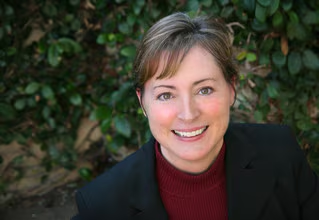
You can read the legal complaint made by the SEC by visiting this link: https://www.sec.gov/files/litigation/complaints/2025/comp26336.pdf
There is also a press release on the SEC’s website about this scam that ran thru New Hampshire: https://www.sec.gov/enforcement-litigation/litigation-releases/lr-26336
Explore by category
Antitrust
Monopolies and anti-competition tactics used to crush rivals.
View Cases →Product Safety Violations
When companies sell dangerous goods, consumers pay the price.
View Cases →Environmental Violations
Pollution, ecological collapse, and unchecked greed.
View Cases →Labor Exploitation
Wage theft, worker abuse, and unsafe conditions.
View Cases →Data Breaches & Privacy
Misuse and mishandling of personal information.
View Cases →Financial Fraud & Corruption
Lies, scams, and executive impunity that distort markets.
View Cases →Intellectual Property
IP theft that punishes originality and rewards copying.
View Cases →Misleading Marketing
False claims that waste money and bury critical safety info.
View Cases →