
What It Costs To Be Sold A Fake Cure
This case is built on three diseases people fear most: cancer, Parkinson’s, and COVID-19. The company sold products it claimed could treat all three, to the exact people most desperate to believe it.
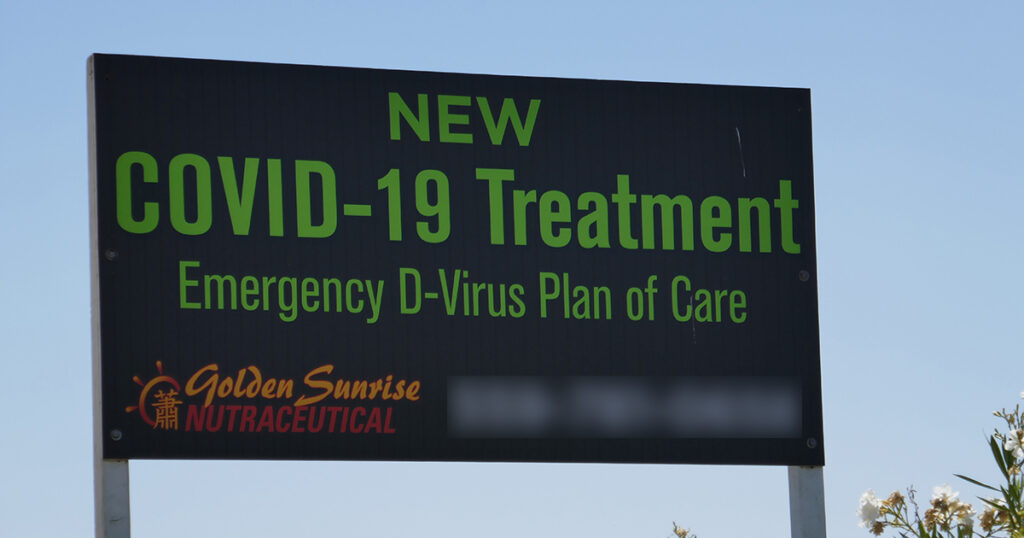
The products carried the language of real medicine. Buyers did not get a bottle of pills with a vague wellness promise; they got an “Emergency D-Virus Plan of Care,” a “Metabolic Plan of Care,” and a “Cancer Plan of Care.” That framing is designed to make a sick person feel they are finally receiving treatment. The court found there was no competent and reliable scientific proof that any of it worked.
The betrayal here is specific. A person facing a cancer diagnosis or a COVID-19 infection has limited time and limited money, and both were taken on a false promise. Some buyers were carried into debt for these products, debt the court has now ordered erased. The dignity cost is harder to undo: people trusted a “Plan of Care” with their health, and the plan was a sales pitch.
Legal Receipts
Every line below is taken word for word from the court’s order and its mandated customer notice.
“There is no competent and reliable scientific proof that the Emergency D-Virus Plan of Care can treat, cure, or lessen the symptoms of COVID-19.” Permanent Injunction, Attachment A (customer notice)
- This is the company’s own ordered admission that its flagship COVID-19 product had no science behind it.
- It was branded “Plan of Care,” clinical language attached to a product with zero clinical support.
“There is no competent and reliable scientific proof that the Metabolic Plan of Care or Cancer Plan of Care can treat, cure, or lessen the symptoms of cancer.” Permanent Injunction, Attachment A (customer notice)
- Cancer patients were a target market, and two separately branded plans made the same unproven cancer claim.
- The court required this correction be mailed directly to people who already bought and used the products.
“None of the treatment plans were FDA approved, designated as Regenerative Medicine Advanced Therapies, or designated safe and effective by the FDA.” Permanent Injunction, Attachment A (customer notice)
- No federal agency ever vouched for these products on safety or effectiveness.
- The reference to “Regenerative Medicine Advanced Therapies” shows the company reached for a serious FDA designation it never held.
“Collecting upon or making any attempt to collect upon any debt arising from the sale of a Covered Product.” Permanent Injunction, Section VI (conduct the court permanently enjoined)
- This confirms buyers owed money for these products, and that the court had to forbid further collection.
- The same section requires the company to delete those debts from consumers’ credit reporting files.
What You Were Told Versus What Was True
The court’s findings draw a direct line between the company’s claims and the documented reality behind each one.
- The “Emergency D-Virus Plan of Care” was marketed as a COVID-19 treatment; the order records no competent scientific proof it does anything for COVID-19.
- The “Cancer Plan of Care” and “Metabolic Plan of Care” were sold as cancer treatments, with no scientific proof behind the cancer claims.
- The “Metabolic Plan of Care” was also pushed for Parkinson’s disease, again with no scientific proof.
- Marketing implied federal standing, including the “Regenerative Medicine Advanced Therapy” label; none of the plans were FDA approved or designated.
“None of the treatment plans were FDA approved, designated as Regenerative Medicine Advanced Therapies, or designated safe and effective by the FDA.”
The Gap That Let It Sell First
Dietary supplements can reach buyers without the government approving whether they work, and the company operated inside that gap.
- The order classifies these items as “Dietary Supplement, Food, or Drug,” categories that can be sold without FDA pre-market approval of efficacy. The deception was the disease claims layered on top.
- The company reached for an FDA “Regenerative Medicine Advanced Therapy” designation it never held, blurring an unapproved supplement into something that sounds federally vetted.
How The Lie Traveled To The Shelf
The deception did not stop at the company. It moved through the retailers and resellers that put these products in front of buyers.
- The order requires the company to notify all retailers or resellers and have them pull deceptive point-of-sale displays, posters, and other materials. (Section VIII, Attachment C)
- Retail and reseller storefronts carried the cure claims, extending the false message to consumers who trusted the point of sale.
- The order reaches “successors and assigns” and even ingredient suppliers, an attempt to close the upstream and downstream paths the conduct could hide in.
Who This Hit, And How Hard
The documented harms fall on two fronts: public health and the household finances of sick people.
Public Health
- The products targeted people with COVID-19, cancer, and Parkinson’s, conditions where relying on a fake cure can mean skipping real treatment.
- The “Plans of Care” mimicked medical language, which can lead a patient to believe they are receiving legitimate care.
- The court had to order a notice telling former customers there is no scientific proof the plans work, proof that real patients acted on the false claims.
- The COVID-19 claims landed during a public-health emergency, when accurate information was a matter of survival.
Economic Harm To The Sick
- Consumers paid for products with no proven benefit, and some were pushed into debt for them.
- Those debts were reported to consumer reporting agencies, damaging credit; the order forces their deletion. (Section VI)
- The order’s automatic financial relief is debt cancellation; it specifies no refund for those who already paid in full.
- The buyers were people seeking treatment for serious illness, a group least able to absorb the loss.
A Stop Order Is Not A Reckoning
A full finding of liability produced an order to stop, not a return of what was taken.
- Liability was established by summary judgment, yet the order’s terms impose no monetary penalty on the defendants.
- The clearest consumer financial relief is the cancellation of debts from these sales; consumers who already paid cash are not refunded by the order’s terms.
- The mandated customer notice is signed by Huu Tieu as “Former President,” a title change that admits the conduct in words but not in dollars.
This Is The System Working As Intended
The facts here show a system that lets a harm run for years, then answers it with a mostly forward-looking order.
- Covered products were sold from at least December 2016; the permanent injunction did not arrive until October 17, 2025.
- The FTC filed suit in 2020 (case 1:20-cv-01060); years passed between the complaint and judgment.
- The supplement framework let these products sell first and face scrutiny later.
- The order locks in 20 years of monitoring and compliance reporting, an admission that the conduct’s recurrence is treated as a real, lasting risk.
What A Legitimate Fix Looks Like
The core failure this case exposes: unproven products can reach sick people first, and accountability arrives years later with no money returned.
Regulatory Track- The FTC and FDA should require human clinical substantiation before any product can be marketed for a disease like cancer, COVID-19, or Parkinson’s, the exact proof this order shows was missing.
- Retailers and resellers should be required to verify a manufacturer’s substantiation before displaying health claims at the point of sale, since this case shows the deception traveled through storefronts.
- Restore and strengthen the FTC’s ability to win monetary redress for deceptive health claims so a liability finding can return money, not just stop future claims. (General reform; not a finding of this order.)
- Close the dietary-supplement gap that lets products reach consumers without pre-market proof of efficacy for disease claims.
- Mandate automatic, funded consumer redress in deceptive-health-claim judgments so refunds do not depend on a separate, unquantified process.
- Bar individuals found liable for deceptive health marketing from majority ownership or control of any health-product business, extending the order’s existing 20-year reach.
- Require an independent compliance officer and pre-publication review of every health claim, building on the recordkeeping the order already mandates.
What Now?
Direct your energy at the operators named in this case (Golden Sunrise Nutraceutical, Inc., Golden Sunrise Pharmaceutical, Inc., Huu Tieu, and Stephen Meis, M.D.) and the agencies that police health fraud.
- Watch the FTC enforcement page for this case (matter 202-3146) for compliance updates and any redress.
- Watch the FDA, which never approved these plans, for action on similar disease-cure supplements.
- Report suspected health-fraud claims to the FTC at ftc.gov and to your state attorney general.
- Support local patient-advocacy and mutual-aid groups that help sick people afford real, evidence-based care.
- Organize to share verified medical information in your community so desperate buyers are not the only market these sellers find.
The source document for this investigation is attached below.
The FTC has a settlement page for Golden Sunrise which includes additional links to pertinent information about this story: https://www.ftc.gov/enforcement/refunds/golden-sunrise-settlement
Explore by category
Antitrust
Monopolies and anti-competition tactics used to crush rivals.
View Cases →Product Safety Violations
When companies sell dangerous goods, consumers pay the price.
View Cases →Environmental Violations
Pollution, ecological collapse, and unchecked greed.
View Cases →Labor Exploitation
Wage theft, worker abuse, and unsafe conditions.
View Cases →Data Breaches & Privacy
Misuse and mishandling of personal information.
View Cases →Financial Fraud & Corruption
Lies, scams, and executive impunity that distort markets.
View Cases →Intellectual Property
IP theft that punishes originality and rewards copying.
View Cases →Misleading Marketing
False claims that waste money and bury critical safety info.
View Cases →Related posts:
 An investigative deep dive into Zycal Bioceuticals’ false bone growth supplement claims, capitalism’s broken promises, and the economic fallout for communities.
 Nudge LLC: A cautionary tale of how celebrity hype, high-pressure sales, and weak oversight collided in a $400M real estate fiasco.
 H&R Block Fined $7M By The FTC For Lying About Its Free Tax Filing Service
 TruHeight lied about their dietary supplements.
