A River of Cyanide: Cleveland-Cliffs’ Cost of Doing Business
The Non-Financial Ledger
A $3 million penalty is a rounding error for a corporation that produces five million tons of steel a year. The real cost is never listed on their balance sheets. It’s paid by the community, by the ecosystem, by us. The real cost is a river choked with dead fish, their bodies floating on the surface as a testament to corporate negligence. It’s a National Lakeshore, a public trust, suddenly poisoned and declared off-limits. Families planning a day at the beach were met with closure signs because a company’s pump failed.
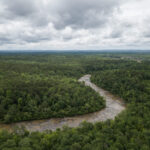
The cyanide release killed hundreds of fish in the East Branch of the Little Calumet River. As a result of the release, Ogden Dunes Beach and the Indiana Dunes National Park were closed for seven days.
There’s also the cost of broken trust. Under the Emergency Planning and Community Right-to-Know Act, Cleveland-Cliffs had a legal duty to immediately warn local authorities about the poison they’d unleashed. They failed. This silence left the community vulnerable and uninformed, robbing them of the chance to take precautions. The settlement documents call this a failure “to provide timely notification.” We call it what it is: a betrayal.
Legal Receipts
The government’s language is often sterile, stripping away the violence of the act. But even in its dry assessment, the failure is absolute. The official complaint filed against Cleveland-Cliffs lays out the core violation in plain terms:
“A pump failure resulted in discharges of untreated cyanide and ammonia nitrogen in exceedance of permit effluent limitations.”
This single sentence translates to a complete breakdown of the systems meant to protect public water. “Exceedance of permit effluent limitations” is the bureaucratic way of saying they dumped illegal amounts of poison into the environment. It was not an accident of nature; it was a failure of corporate machinery and oversight.
Societal Impact Mapping
Environmental Degradation
The damage was immediate and brutal. The unpermitted release of cyanide and ammonia into the East Branch of the Little Calumet River triggered an ecological collapse. The EPA confirmed the event killed hundreds of fish, a visible and devastating blow to the local waterway. This river is not an industrial sewer; it is a living ecosystem that flows directly into Lake Michigan. The impact rippled outward, contaminating a protected natural area, the Indiana Dunes National Lakeshore, forcing its closure.
Public Health
Direct human casualties were not reported in the source, but the threat was real enough to shut down public access. The closure of Ogden Dunes Beach for a full week demonstrates the potential for public harm. Cyanide and ammonia are highly toxic. The settlement will result in expected decreases of these pollutants, as well as toxicity, phenolics, and oil and grease, all of which pose risks to human and environmental health. The delayed notification meant people could have unknowingly been exposed before the official warnings were issued.
Economic Inequality
Cleveland-Cliffs’ Burns Harbor facility is one of the largest integrated steel mills in North America. Its capacity to produce 5 million tons of steel per year represents immense industrial and economic power. The penalty for poisoning a river, killing its wildlife, and shutting down a national park was just $3 million. This amount is trivial for an operation of this scale. It presents pollution not as a catastrophe to be avoided at all costs, but as a minor line item, a manageable expense in the pursuit of profit.
The “Cost of a Life” Metric
What Now?
The settlement imposes new requirements, but history shows that without relentless public pressure, corporate promises are just paper. True accountability comes from us.
Corporate Roles to Watch
- ExecutivesCorporate Leadership at Cleveland-Cliffs Steel LLC
- BoardBoard of Directors at Cleveland-Cliffs Burns Harbor LLC
Regulatory & Community Watchlist
- FederalU.S. Environmental Protection Agency (EPA)
- StateIndiana Department of Environmental Management (IDEM)
- ResistanceEnvironment and Law Policy Center (ELPC)
- ResistanceHoosier Environmental Council (HEC)
The inclusion of citizen groups ELPC and HEC as co-plaintiffs was critical. Their involvement led to the company being forced to donate 127 acres of land to the Indiana Dunes National Lakeshore. This is the path forward. Support local environmental councils. Demand that the EPA and IDEM enforce permit limits with an iron fist, not just with after-the-fact fines. Organize mutual aid networks for community-led water testing. They have the money, but we have the numbers.
The source document for this investigation is attached below.
The EPA has a webpage with an overview of this violation: https://www.epa.gov/enforcement/cleveland-cliffs-steel-llc-and-cleveland-cliffs-burns-harbor-llc-settlement