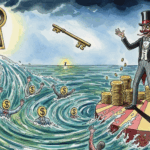
Voyager’s $1.7 Billion Con
How Voyager Digital and its CEO turned everyday people’s crypto savings into the fuel for a scheme the government itself called “indistinguishable from a Ponzi.”
Filed: October 12, 2023 | CFTC v. Stephen Ehrlich
While Voyager’s CEO was tweeting that “customer assets are safe,” his own executives were privately calculating they had roughly one to two days of liquidity left before the whole thing collapsed on top of the ordinary people who trusted them.
The “Safe Haven” That Was Anything But
They Sold You Security. They Delivered Recklessness.
From at least mid-2018 through the summer of 2022, Voyager Digital built its entire brand on a single promise: your crypto is safe with us. CEO Stephen Ehrlich co-authored a white paper in November 2019 pledging that Voyager would operate with “the same level of rigor and trust that financial institutions afford,” and that funds would be “always secure and liquid ensuring that your funds are safe and available when you need them.” The platform’s website called itself a “safe haven” in a volatile market. These were not mere slogans. According to the federal complaint, these promises of safety were “central to Voyager’s marketing.”
To sweeten the deal, Voyager launched a Rewards Program starting around October 2019 that promised returns as high as 12% annually (more than twenty times what most savings accounts paid at the time). Voyager’s marketing called these rates “a significant premium to traditional savings accounts, especially with interest rates near zero.” The pitch was irresistible: keep your assets on Voyager, earn big, and sleep easy knowing they’re protected. During the relevant period, customers stored more than $2 billion (enough to build 40 fully equipped public hospitals) worth of digital assets on the platform.
The fine print told a different story — but it was buried. Voyager’s user agreement, in its August 2021 version, was 30 pages long and over 17,000 words of single-spaced text. Buried inside, Voyager reserved the right to “pledge, repledge, hypothecate, rehypothecate, sell, lend, or otherwise transfer” customer assets and use them at “the customer’s own risk, including the risk of losing all of a customer’s cryptocurrency.” The complaint is direct: these disclosures “would not have made a reasonable Voyager customer aware” of the reckless lending that was actually happening behind the scenes.
The FDIC Lie That Never Should Have Happened
On approximately December 18, 2019, Voyager published a claim on its blog that “all customers’ USD held with Voyager is now FDIC insured” and that in the event of “the company or our banking partner’s failure, you are guaranteed a full reimbursement (up to $250,000).” The federal complaint states plainly that this was false. FDIC insurance protects depositors when a bank fails. It does not protect customers when a crypto platform fails. Voyager was neither a bank nor FDIC-insured in the sense it claimed. Customers who read that blog post and believed it were making decisions based on a lie.
Voyager’s Loans to High-Risk Counterparties ($ Millions)
Sources: CFTC Complaint paragraphs 6, 108, 129. Firm A total exposure cited as $685M+ at peak. Total outstanding loans cited as approximately $1.7 billion in Ehrlich’s own email.
The Scheme: One Sentence Letter. $685 Million Gone.
Due Diligence That Was Never Done
In early 2022, Voyager identified a hedge fund (Firm A in court documents) as a potential massive borrower of pooled customer assets. When Voyager asked Firm A for audited financial statements, Firm A refused. Instead, a Firm A co-founder sent a letter with a single sentence asserting a net asset value — no supporting documentation, no auditor, no verification of any kind. Voyager’s team discussed internally whether to accept this. They decided to proceed. Ehrlich himself approved the relationship.
Firm A’s own website carried a prominent disclaimer warning visitors that investing with Firm A was “only suitable for sophisticated investors who can bear the loss of a substantial portion or even all the money they invest in the Fund.” Voyager’s own Loan Risk Committee members visited that website and read that disclaimer before approving hundreds of millions of dollars in transfers. Voyager personnel did not receive income statements, cash flow statements, balance sheets, or even a debt-to-asset ratio. No stress testing of liquidity was conducted. Multiple people involved in the diligence process lacked backgrounds in credit risk evaluation.
The Master Loan Agreement Ehrlich signed with Firm A actually stated that Firm A had provided “historical financial statements audited by independent certified public accountants.” Voyager knew this was false — Firm A never provided any financial statements at all. Ehrlich signed it anyway. According to the federal complaint, Voyager transferred over $650 million (enough to cover four years of tuition for 43,000 students at a public university) of pooled customer assets to Firm A. Every dollar was unsecured. Firm A never repaid a cent.
Every Other Counterparty Voyager Called “Low Risk” Also Went Bankrupt
The Firm A catastrophe was not an isolated failure of judgment. Voyager’s diligence process was broken across the board. On January 28, 2022, Voyager evaluated Firm C and concluded it was “low risk.” Firm C went bankrupt. On February 22, 2022, Voyager evaluated Firm B and concluded it was “low risk.” On June 13, 2022, Ehrlich privately confided to a professional athlete that Firm B was “a house of cards.” Firm B later went bankrupt. Voyager also evaluated Firm D as “low risk.” Firm D went bankrupt in 2022. Four for four. Every counterparty Voyager called safe went under.
During this period, entities including Firm A, Firm B, and Firm D each held over 25% of Voyager’s total assets at various points. The complaint states that Voyager’s “loan” counterparties collectively held over $2 billion (more than 50,000 median American workers earn in a year combined) of Voyager’s assets during the relevant period. The company was structurally incapable of honoring customer withdrawals if even one major counterparty failed. One did. And Voyager collapsed.
When the Terra Ecosystem Burned, Voyager Looked the Other Way
By early May 2022, the Terra/Luna blockchain ecosystem was in freefall. The UST stablecoin collapsed from $1 to approximately 2 cents. LUNA fell from roughly $80 to less than a cent. Voyager personnel knew Firm A was a “big investor” in the Terra ecosystem. They discussed it internally. Firm A’s involvement was publicly reported in news articles. On May 9, 2022, a Voyager employee wrote internally that Firm A “has a natural long BTC position so has the inventory to sell” and flagged the risk explicitly. Voyager’s response was to ask Firm A if things were okay. Firm A said yes. Voyager accepted that with no follow-up diligence.
When Voyager needed to recall some USDC in mid-May to address its own “operational liquidity” issues, Firm A pushed back and suggested keeping all the money — but offered an extra percentage point or two in return. Voyager agreed. The company chose a slightly higher interest rate over getting its customers’ money back. On May 23, 2022, Firm A sent another one-sentence “AUM Letter” showing its net asset value had dropped by 31% since January — a drop of hundreds of millions of dollars. Nobody at Voyager asked what caused it.
The Rewards Program vs. The Reality: Key Events Timeline
Key dates sourced directly from CFTC Complaint paragraphs 4, 39, 71–73, 95, 127–129.
The Cover-Up: Tweeting “Safe” While Watching It Burn
June 12: The Lie Goes Public
On June 12, 2022, as Voyager scrambled internally to understand its catastrophic exposure to the failing Firm A, the company’s official Twitter account posted a statement that Ehrlich retweeted from his personal account: “All Voyager products and services are fully operational and remain unaffected by current market conditions, including trading, rewards, deposits, and withdrawals. We take risk management very seriously, and safeguarding customer assets is our number one priority.” The company also stated it had “never engaged in DeFi lending activities” and had “no exposure to stETH” — both of which the federal complaint states were false, because Voyager had significant exposure to both through Firm A.
The very next day, June 13, Voyager recalled 1,250 BTC from Firm A. On June 14, it recalled everything — 14,000 BTC and 350 million USDC — and requested repayment within two days. Firm A never repaid a single asset. On June 14, the same day Voyager was desperately trying to claw back its customers’ money from a collapsing counterparty, Ehrlich tweeted a media article headlined “EXCLUSIVE: Voyager Digital CEO Says ‘Customer Assets Are Safe’ Amid Crypto Collapse.” The article quoted Ehrlich: “Our financials are public. You can see everything about us.”
The complaint documents why this was false. Voyager’s public financials listed the Firm A counterparty only by geographic location: “Singapore.” The public financials also stated Voyager’s exposure to that Singapore counterparty was $326 million (enough to pay 8,000 workers the median U.S. salary for a year). The real exposure at that moment was over $685 million (enough to fund the entire annual budget of a mid-sized American city). Ehrlich knew the difference. He said nothing.
The Regulators Saw It. Ehrlich Stalled Them Too.
Canadian securities regulators, who had oversight of Voyager’s Toronto Stock Exchange listing, repeatedly pressed Voyager to disclose more. Voyager’s internal response, documented in the complaint, was strikingly candid: if customers received accurate information about Voyager’s exposure to Firm A and its deteriorating financial condition, those customers “would likely withdraw their assets from the Voyager Platform, resulting in Voyager’s failure.” Voyager used that rationale to argue against disclosure — to regulators — while simultaneously telling customers everything was fine.
When the Ontario Securities Commission specifically asked how the June 17 press release (announcing a credit line from Firm B) “was not misleading given that there was no mention of the potential default of the Firm A loan,” Voyager offered no satisfying answer. Voyager’s position, stated directly in a confidential regulatory filing, was that it would only tell the public how bad things were “when the Company has determined that it is necessary to cease satisfying customer withdrawal requests.” Translation: Voyager planned to tell customers the truth only once it was too late for them to do anything about it.
One to Two Days Left. Ehrlich Said: “Thanks.”
On June 23, 2022, with Firm A gone and the money lost, Voyager’s Executive 1 wrote internally: “It is safe to say that if conversions from USDC to USD continue at the pace we saw today we have about 1 day if we get the 75MM from Firm B, 2 days if we get the 100MM novation.” That same day, when Ehrlich reviewed a financial forecast prepared for Firm B, he asked “is it that bad or did we put a cushion in here?” The answer came back: “no cushion.” On June 25, 2022, Ehrlich was updated that customers “have actually bought more BTC than sold for the day.” Another employee wrote “This is very good news.” Ehrlich replied: “Yep.” People were still putting money into a platform that had days to live.
The Human Cost They Never Counted
Over $1.7 billion (enough to fully fund a $1 million home for 1,700 families, or to send 85,000 students to a four-year public university debt-free) vanished from the accounts of ordinary Americans who trusted Voyager because Voyager told them to. These were not institutional investors with teams of lawyers. These were people who read Ehrlich’s white paper promising the “same level of rigor and trust that financial institutions afford” and believed it — because why wouldn’t they? The language was designed to sound like a bank. The promises were designed to feel like a guarantee. The betrayal was total.
The Rewards Program was specifically targeted at a generation of people who had been burned by decades of near-zero interest rates, priced out of housing markets, and told that traditional savings accounts were the responsible choice — even as those accounts paid fractions of a percent in returns. Voyager promised up to 12% annually, in an era of 0% savings rates. That pitch landed hardest on the people who needed it most: younger workers trying to build any kind of financial cushion, people putting in small amounts hoping crypto might be their one shot at getting ahead. The complaint documents that customers were actively purchasing and depositing new money onto the platform at the rate of $500,000 to $1 million per hour as late as June 18, 2022 — six days before the company effectively ran out of road. Those people made those decisions while Ehrlich and his team watched the real numbers and said nothing.
The FDIC insurance claim — falsely posted in December 2019 and never adequately corrected — deserves its own accounting. FDIC insurance is one of the foundational trust mechanisms that Americans rely on when deciding where to put their money. Invoking it falsely is not a technical error. It targets the specific psychological shortcut that ordinary people use to feel safe with their money: government-backed protection. Every person who read that blog post and decided Voyager was safe because of it was operating on false information, planted deliberately by the company.
And then there is the dignity of it. The complaint documents Voyager watching the pace of customer withdrawals in real time, treating new deposits as the lifeline keeping the scheme alive, monitoring the ratio of purchases to withdrawals the way a gambler watches a scoreboard. While customers believed their assets were “fully operational and remain unaffected by current market conditions,” Ehrlich’s team was counting BTC in near-real-time and rationing recalls from counterparties to stay one day ahead of collapse. The people pouring money in were not market participants making informed decisions. They were, as the government’s complaint explicitly states, the equivalent of unknowing depositors in a Ponzi scheme — funding the payouts to those leaving, while being kept in the dark about exactly how little time remained.
The Receipts: Direct From the Government’s Own Filings
“Voyager’s mad dash to fatten the Voyager Platform while concealing its actual financial condition was, by this stage, indistinguishable from a Ponzi scheme — securing contributions from uninformed new depositors to pay back prior depositors who requested their money back, all while keeping everyone in the dark regarding its actual deteriorating financial condition.”
CFTC Complaint, Paragraph 11 and Paragraph 115 — The government’s own characterization of Voyager’s final weeks of operation.
“Voyager’s position was, essentially, that it did not want the public to know how bad things were, because if the public knew how bad things were, customers would not continue to store their assets on the Voyager Platform; and that Voyager would only tell the public how bad things were once it was too late for customers to do anything to protect themselves.”
CFTC Complaint, Paragraph 126 — Summarizing Voyager’s stated rationale for withholding disclosure from regulators and the public.
“Ehrlich also expressed dissatisfaction that the Loan Risk Committee ‘has 2 lawyers’ and expressed the need ‘to rethink risk committee. Shouldn’t be dominated by legal.'”
CFTC Complaint, Paragraph 49 — Ehrlich’s response upon learning Firm A “may be a massive borrower,” before any due diligence was conducted. He moved to reduce legal oversight of the risk committee.
“On June 13, 2022, while still officially concluding Firm B was low risk, Ehrlich privately confided to a professional athlete, ‘My biggest fear is that [Firm B] is a house of cards. Not for us but will blow up the industry.'”
CFTC Complaint, Paragraph 57 — Ehrlich’s private statement about one of Voyager’s largest remaining counterparties, made on the same day Voyager publicly claimed it used “extensive due diligence” on all partners. Firm B later went bankrupt.
“After reviewing the forecast, Ehrlich asked, ‘is it that bad or did we put a cushion in here?’ Executive 2 replied with various pieces of information, concluding with ‘no cushion.'”
CFTC Complaint, Paragraph 123 — June 23, 2022. Voyager had days of operational liquidity left. Ehrlich’s first instinct upon reading the financial forecast was to ask whether the numbers had been softened before showing them to a counterparty.
Societal Impact Mapping
Economic Inequality: Who Gets Hurt When Crypto “Safe Havens” Fail
The Voyager collapse did not hit Wall Street. It hit the people Voyager deliberately targeted with language about “safe havens,” interest rates that dwarfed anything a bank would offer, and promises that their money would be treated with “the same level of rigor and trust that financial institutions afford.” The Rewards Program, offering returns up to 12% annually, was engineered to attract exactly the kind of customer who could least afford to lose everything: people with limited savings who had been told for years that traditional finance had nothing to offer them, and who saw crypto’s upside as the one accessible opportunity in a rigged economy.
The false FDIC insurance claim compounded the harm along class lines. The people most likely to be reassured by the phrase “FDIC insured” are people who have never had enough capital to need lawyers, financial advisors, or risk consultants. The FDIC promise is, for working people, the floor of financial safety. Invoking it falsely — for years — systematically misled exactly the customers least equipped to independently verify the claim. When Voyager went bankrupt, those customers faced losses with no government backstop and no legal
Here is a link on the CFTC website about a $750K restitution that Voyager was forced to return to the victims of the scam on Sept 15th 2025: https://www.cftc.gov/PressRoom/PressReleases/9122-25
Related posts: