
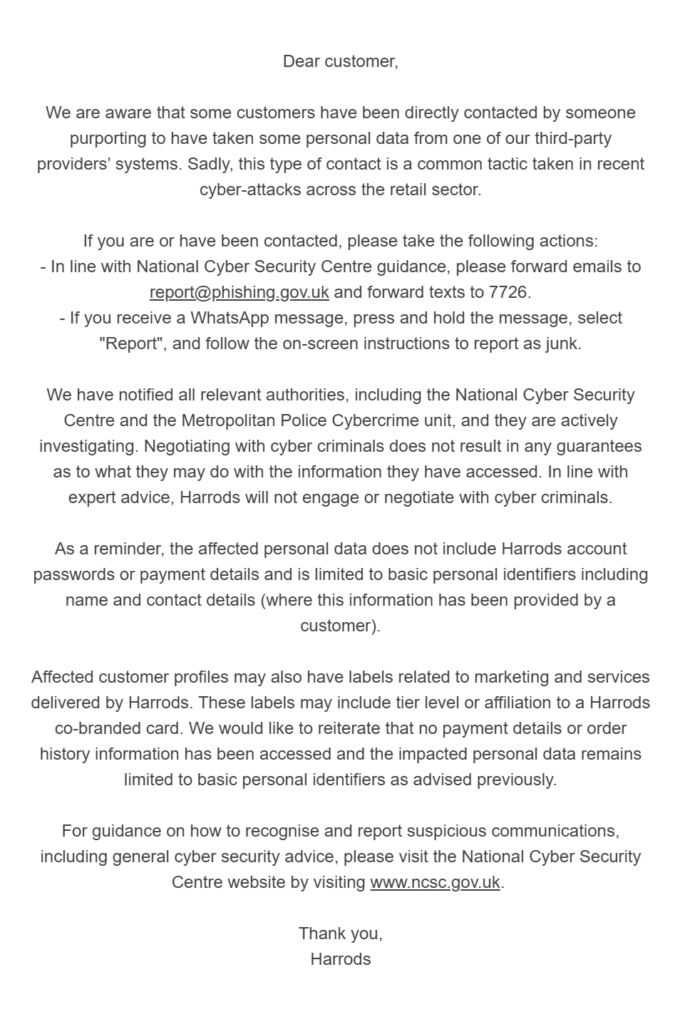
I just got an email from Harrod’s stating that many of its customers recently suffered a data breach of our personal information.
According to a notice sent to affected customers, that stolen personal information is now being actively used in phishing and junk message campaigns, placing the burden of defense squarely on the victims of the breach.
How the System Failed
The incident showcases a critical vulnerability in modern retail: the distributed risk of outsourcing. While Harrods’ own core systems were not compromised, its choice of a third-party vendor with inadequate security led to the exposure of customer data.
The company’s own notice outlines a clear sequence of systemic failure.
- Initial Breach: An unnamed third-party provider used by Harrods suffered a security failure, allowing unauthorized access to its systems.
- Data Compromised: The breach exposed what Harrods terms “basic personal identifiers,” including customer names and contact details. Critically, this also included marketing-related labels, such as a customer’s “tier level or affiliation to a Harrods co-branded card,” giving criminals valuable context for targeted scams.
- Data Weaponized: Cyber criminals are now using this stolen information to “directly contact” customers through phishing emails and WhatsApp messages, impersonating official sources to commit further fraud.
- Responsibility Shifted: Harrods’ official response instructs customers to individually forward malicious emails and report junk messages, effectively offloading the initial line of defense against the consequences of the breach to the affected individuals.
- Limited Corporate Action: While notifying UK authorities, Harrods has stated it “will not engage or negotiate with cyber criminals,” leaving the compromised data permanently in the hands of those now using it to target the store’s customers.
The Consequences
The Erosion of Trust
The core consequence of this breach is the systemic erosion of consumer trust, not just in Harrods, but in the entire retail ecosystem that relies on a complex and opaque web of third-party data processors. The email confirms that customer data (including status identifiers like tier levels) was entrusted to an external entity that failed to protect it.
By choosing this vendor, Harrods accepted a risk on behalf of its customers, and that risk has now materialized as direct, personal harassment.
The company’s response, which focuses on advising customers on how to protect themselves after the fact, highlights a fundamental breakdown in corporate accountability for security.
The message is clear: when our partners fail, you are the final line of defense. Ugh.
The Bottom Line: Accountability & The System
The official response has been to notify the National Cyber Security Centre and the Metropolitan Police Cybercrime unit, who are “actively investigating.” However, this procedural step does nothing to contain the immediate damage. There is no mention of fines, restitution for customers, or credit monitoring services.
This incident is symptomatic of a larger systemic issue where corporations delegate data management but cannot delegate the ultimate responsibility for its protection.
The breach here was a failure of oversight and accountability. While Harrods states that “no payment details or order history” were lost, the theft of personal identifiers and marketing data has proven to be sufficient ammunition for criminals to launch targeted attacks.
Related posts:
 35,000 people had their personal data leaked including social security numbers, drivers license details, and health insurance info | CSC ServiceWorks
 LinkedIn exposed your private messages to train AI models
 How SpyFone Built a Business on Stalking and Domestic Abuse.
 167,000 Ruger Owners Had Their Private Data Exposed
